
From April 2028, electric and plug-in hybrid cars will pay a new tax based on how far they travel. The government confirmed the details of electric Vehicle Excise Duty (eVED) on 13 July 2026, including special arrangements for fleet operators and leasing companies.
If your business runs electric company cars or offers an EV salary sacrifice scheme, eVED is now a cost to plan for. A 48-month contract signed this autumn would run until late 2030, so more than half of it falls under the new tax. This guide explains what eVED costs, who pays it, how fleets will report mileage and what to do before 2028.
For the background on how pay-per-mile works for private drivers, see our earlier guide, pay-per-mile road tax: what this means for you.
eVED is a mileage-based charge that sits alongside Vehicle Excise Duty (VED), the annual road tax. It starts on 1 April 2028 and will be run by DVLA through the existing VED system (HMRC policy paper, 13 July 2026).
The government says the 3p rate is about half the equivalent rate of fuel duty paid by petrol and diesel drivers. Mileage driven abroad in a UK-registered car still counts, and the government has ruled out charging by where people drive (eVED consultation response, GOV.UK).
Separately, the threshold for the VED expensive car supplement rose from £40,000 to £50,000 for zero emission cars from 1 April 2026 (GOV.UK). That helps business buyers of mid-priced EVs, and it is a separate change from eVED.
The sum is simple: annual miles multiplied by the rate. At the starting rates, a fully electric car covering 10,000 miles a year would pay £300, at 20,000 miles £600, and at 30,000 miles £900. A plug-in hybrid pays half: £150, £300 and £450.
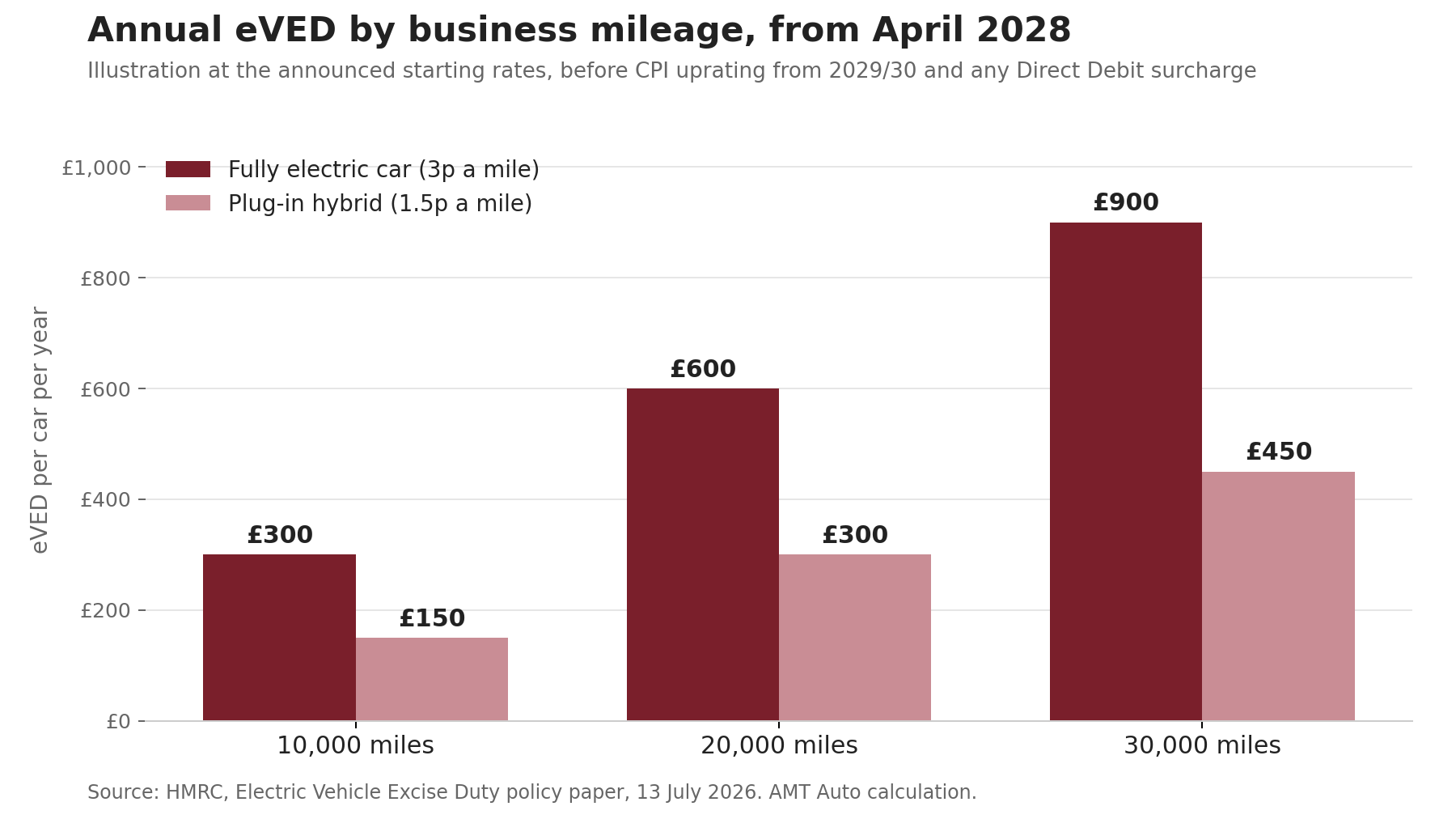
Two things push the real figure up over time. Rates rise with inflation from 2029/30, and paying in instalments by Direct Debit carries a 5% surcharge, as it does for VED today. For most businesses the biggest variable is mileage, so high-mileage roles such as sales and field service will feel eVED most.
The registered keeper is legally responsible for giving mileage readings and paying eVED. Who that is depends on how the car is funded.
If the business is the registered keeper, it pays eVED directly, in the same way it pays VED now.
On most contract hire agreements the leasing company is the registered keeper, so it will deal with DVLA. How the cost reaches you is a contract question. The government hasn't set a rule for how lessors pass eVED on, so check how your agreement treats taxes and duties introduced during the term, and ask your leasing provider how it plans to handle eVED on cars that will still be on the road after April 2028.
Many salary sacrifice packages include road tax in the monthly payment; AMT's salary sacrifice scheme page lists it as included. Whether eVED will be treated the same way is for each scheme provider to confirm. Employers running a scheme should raise it now, because staff signing up today will be paying through the first years of eVED.
If employees use their own electric cars for business journeys, they will pay eVED on all their miles, business and private. HMRC's approved mileage rate for cars is 55p a mile for the first 10,000 business miles (25p after that), the same for every fuel type (GOV.UK). Review your mileage policy before 2028 so staff know what they can claim.
The original proposals worried the fleet sector, and the BVRLA estimated they would add about £260 million a year in compliance costs (BVRLA, 14 July 2026). The confirmed scheme is simpler for businesses:
For private keepers, the process works around the VED renewal: an odometer reading plus an estimate for the year ahead, then a reconciliation against the real figure, with mileage recorded at the MOT used as a check. Penalties for not paying will be based on VED penalties, with an extra level for eVED.
Yes, in most cases. The government says businesses will generally be able to deduct eVED as a business expense, in the same way as VED. It also confirmed that the existing VAT treatment of leased cars carries on: businesses normally recover 50% of the VAT on lease rentals, with the other 50% treated as covering private use (eVED consultation response). Your accountant can confirm how this applies to your business.
It adds a running cost, but it doesn't change the biggest difference between electric and petrol or diesel company cars, which is benefit in kind (BiK) tax. The BiK rate for electric company cars is 4% in 2026/27, rising to 5% in 2027/28, 7% in 2028/29 and 9% in 2029/30 (GOV.UK). Petrol and diesel cars can reach 37%. Employers pay Class 1A National Insurance at 15% on the same benefit value, so a lower BiK rate saves the business money too. Our guide to electric company car tax in 2026/27 sets out the rates in full.
Running costs are the other side. HMRC's advisory electricity rates for company cars, from 1 September 2026, are 7p a mile for home charging and 15p a mile for public charging (GOV.UK). eVED adds 3p a mile on top of the energy cost. Whether an EV still works out cheaper overall depends on each car's price, mileage, charging pattern and contract, which is why a whole-life cost comparison is the right tool. AMT's guide to vehicle whole-life costs explains what to include, and the company car tax calculator shows the BiK side for individual cars.
eVED is 18 months away, and most cars ordered now will still be on the road when it starts. If you're reviewing company cars or vans, AMT's business car leasing team can talk through the options and the running costs to plan for.
This article is general information for businesses, not tax or financial advice. Figures checked on 9 October 2026: HMRC eVED policy paper and consultation response (13 July 2026); BVRLA (14 July 2026); GOV.UK company car tax rates 2028 to 2030 (30 October 2024); GOV.UK advisory fuel rates (updated 21 August 2026); GOV.UK approved mileage rates; GOV.UK expensive car supplement threshold (26 November 2025).
At AMT Auto, we redefine convenience with vehicle solutions designed for both businesses and individuals.
No matter the vehicle or the duration, we’ve got you covered with our exceptional services.
Discover flexible car leasing, car rental, used cars to buy, or subscribe to a car or van with us—you can even sell your current car for the best price. For businesses needing consultancy on fleet management or a partner to supply vehicles to customers, we’ve got it all under one roof.


AMT Global Investments Ltd - Registered in England and Wales No: 05904790. Please note: Whilst every effort has been made to ensure the accuracy of the vehicle information and images, some errors may occur. It is important that you do not rely solely on the information, images or prices shown but confirm with AMT regarding any items that may affect your decision to rent, lease or buy a vehicle. Registered Address: AMT Auto, 4 Bingley Street, Leeds LS3 1LX, Tel: 0113 387 4240.